Prairie Love

There are studies, I suppose, on the ways our physical environments shape us. I don’t mean the obvious environment psychologists talk about; the neighborhood, the house, the presence of books or harsh words. I mean the environment outside the window, the creek, the mountain, the wide open sky, a fence row that goes on forever, the next house a speck on the horizon.


Or no house on the horizon, and sometimes no horizon, either. Where I live, where I have always lived, I must go in hunt of the skyline, and it is a drive.

South Dakota is a land of horizons, of prairie, a place where standing on a second floor balcony the rain comes in from off, signaled by darkening sheets of rain too small to cover the whole horizon, just a part of it. The rain moves back to front, or left to right, and it will reach you some time, but leaving you plenty of time for speculation and a chat.


I want to drive across Nebraska. I am told this is because I have never driven across Nebraska. That the wheat and road are incessant, a trial to be endured, not enjoyed. But I don’t know. I think that sounds like a wonderful thing to see and do. Drive and drive, scenery unchanging, but new to me, and therefore, exciting. The prairie grass rolling like waves, and what it must be to see a rise in the landscape, to see the change coming but not able to judge the distance, not quite yet, and if at all.


I asked people I met out in South Dakota what it was like growing up with the Black Hills for a backdrop, to drive an hour and be in the Badlands. To have so much sky. They smiled and said it was nice, and didn’t quite get the question, as I wouldn’t quite get the question if put to me. One woman said her father, who was a rancher, never looked at the sky all that much. His grandchildren asked why his walked with his head down, always down.


“I raised cows,” he had said. “I have to watch where I step.”


But this must be the exception, surely.


I don’t realize how flat Daviess County is until friends from Eastern Kentucky point it out. They find they can only be away from their mountains for just a little bit before they miss them, the “sheltering hills” James Still wrote of. I can only be in those same mountains for a few days before they begin to close in on me, make me work a little harder to breathe. So, not sheltering to me, but oppressive.


Give me the same mountains farther south, in Tennessee. Then I am tenderhearted toward them. But that is because they roll differently there. Towns and bergs are nestled in broad green valleys, valleys we can look down into from overlooks or the high winding roads. A vista of sorts.


My mother’s people came here from England. I can almost prove it on paper, I think, but I can prove it for certain when I travel there. That green and pleasant land. The gentle landscape that is broad and human-scaled. The fields and meadows, the hillocks that ring a village, the ones with the benches at their crest, inviting us to sit and gaze out on the houses below, and watch the sky change from blue to gray to navy.


I have sat on such benches and feel, in a visceral way, that it isn’t the first time I’ve sat there, and not in this century. I do a lot of sighing then, content, and warm with affection, as I catch my breath.


I feel the same in Ireland, where every rock-bound field sits not too far above sea level. They have their mountains, I think of the Wicklow Mountains, but they are gentle and promise, as one travel books said, “sweeping views and plenty of space to sit and have a cuppa.” Stand at Cumberland Gap and wonder how this could have been the best spot to cross into the West. Then meander up and down Sally Gap Drive in the Wicklow hills for comparison. And there is no comparison, none at all.


Willa Cather, American writer, was born in the Shenandoah Valley, but grew up in Nebraska. She knew something about about mountains, and also vistas, and open sky. She says, this, about that:


“Anybody can love the mountains, but it takes a soul to love the prairie.”


What soul I have for landscape, sits beside Willa Cather’s.

Wall Drug and Then Some

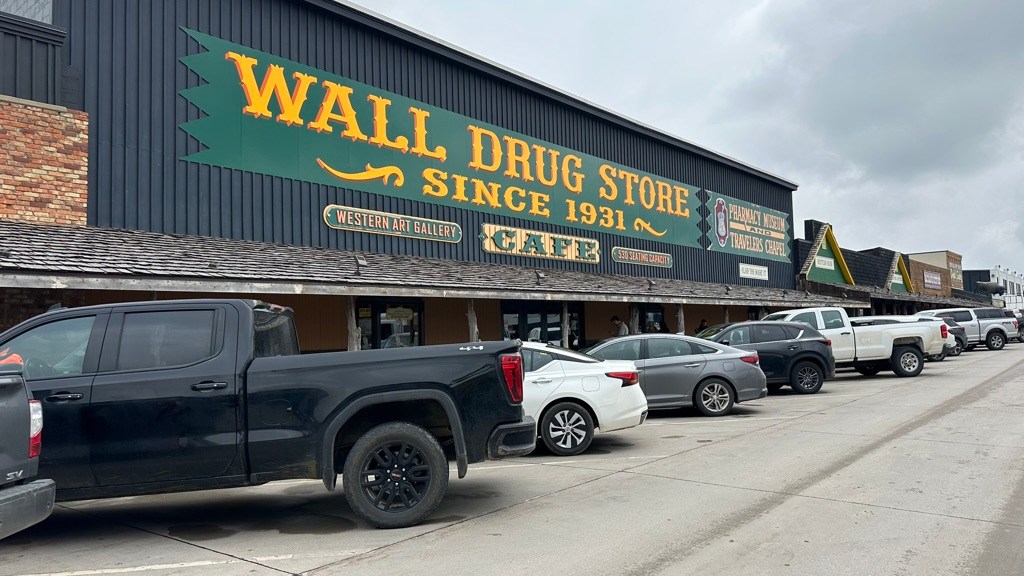
Our first outing was for ice water. Free ice water and sixty miles away. We giggled the whole way there. My pal, Donna, and I had arrived in Rapid City, South Dakota and on our first morning we decided it was too overcast to rush over to Mount Rushmore. We would go to Wall, SD, first and stop in at the drug store for some free ice water.


And cheap coffee.


And donuts.


Last December I found myself with some airline credit that had to be used up so Donna and I headed west to make up for a driving trip we had cancelled during COVID. I had a package to mail, so I brought it with me, and we headed to Wall Drug, with intentions of mailing that package, seeing what all the fuss was about, besides ice water, and then to head into the Badlands.


Well. I have to say, kitsch though it may be, Wall Drug was a favorite, starting with the Burma Shave-like signs that began showing up, twenty miles out. The story goes, Ted Hustead and his young family bought the l drug store in the tiny town of Wall, population 326, in 1931. Giving themselves five years to make a go of it, the timeline was almost up, when his wife, Dorothy, lay down for an afternoon nap one hot and miserable Sunday.


She got up fairly quickly, with an idea of how to entice all the travelers rolling down highways 14 and 16, just outside Wall. Those people are thirsty, she said. What do they want? Ice water!


She had even dreamed up the little jingle that would bring the travelers in. 
 “Get a soda…get a root beer…turn next corner…just as near…free ice water…Wall Drug.”

And that, my friends, is how you do it. After the homemade signs went up out along the prairie roads, the cars started coming and they haven’t stopped since.


Now, Wall Drug is just about what you would expect. A sprawling enterprise that takes up an entire city block, one can envision an Old West wooden sidewalked city block, and it has so many little shops and emporiums it is hard to locate the original Wall Drug store. But it is in there somewhere, and I bought some fancy sea salt lotion, just to prove it. They have old timey picture studios, with hat and bonnet props, gem and rock shops, any one of several souvenir shops, and stations out back for all that free ice water.


On the day we visited the water was dispensed from a regular soda fountain, but it was very cold. I know I am suggestible, but I defy you find colder water anywhere. Donna generously treated me to that five cent coffee, which I couldn’t drink, but she enjoyed because, you know, a nickel. I would have gladly paid a dollar for someone to take it from my lips.


But the donuts!


Oh, my, the donuts were wonderful. And I don’t usually like this kind of donut, but these were warm and cakey, but also a little yeasty, and I have no idea why we didn’t buy an entire bag of them–they were sitting right there on the counter–but now I want to see if they can ship them.


It is a roadside attraction of the most American kind. The coffee and donuts were added to the tradition when they installed the Minuteman missile silos in the area. The Husteads figured the military personnel would want cheap hot coffee and donuts on their travels to and from work. And, it turns out, so did we.

We spent an hour wandering around like good tourists do, and headed out for the Badlands, a place I have heard of forever but couldn’t have described to save my life. There is much to say about them, and I will, but for now, two words: prairie dogs. Okay, three words: prairie dog villages.

Ask anyone and they will tell you, I am not much of an animal lover. But, you all. I have never seen anything cuter than those little praise dogs. And they really do live in villages, and they, along with my donuts and ice water, were my first introduction to South Dakota and I was smitten.

Some Notes on the Passing Scene

My hostas have survived construction. Also the hydrangea, the big white ones with blooms the size of basketballs. I carefully dug the hydrangea up and put them in pots, covered them with straw and watered them off and on. The hostas I transplanted, neglected and hoped for the best.
Both seem to have weathered the winter, big old work boots and harsh treatment and I expect them to make a full recovery.


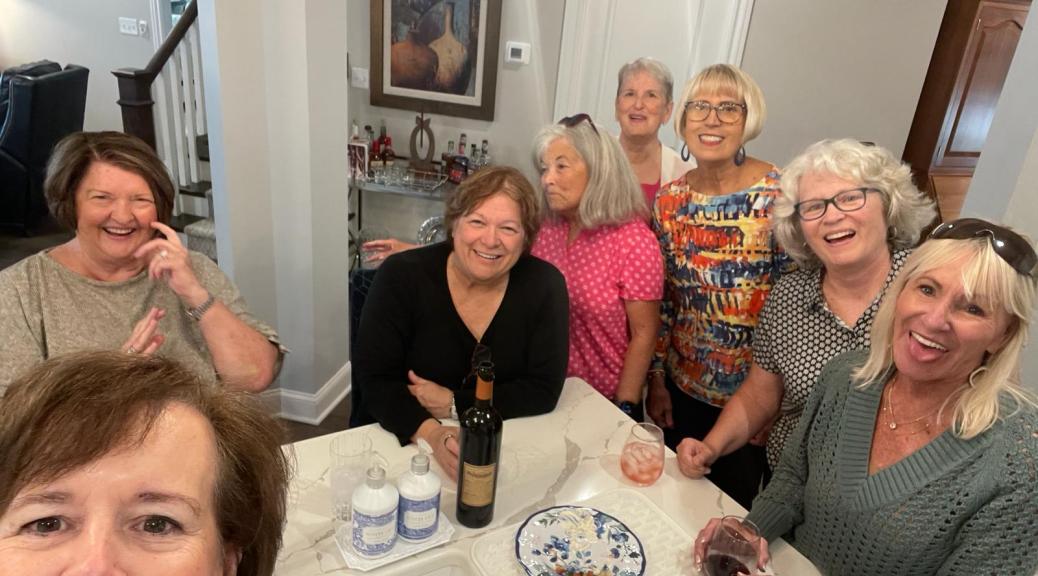
The house is almost done, or done enough I had friends over for a quick viewing. They were only allowed in new part of the house, since the rest of the house looks much like I imagined Ebenezer Scrooge’s storeroom–dark, dank, dusty and covered in cobwebs. Nine of us from our girls’ group made it to town for lunch on Monday. Only Patty, vacationing in Hilton Head, or making her way back home to Florida, missed it. Linda came from St. Louis, Julie from Bardstown, Janet came from work.


The rest of us gathered at Ruth Ann’s and talked over each other, ate, and ate some more, enjoying her new digs — so much more put together than mine — and I swear it felt like a holiday. I think it may be the first time since COVID and our various retirements from employment that we have gotten together in an impromptu fashion. It was fun.


And then, our old high school pal, Kathi, joined us for a little bit, since she and Nancy drove down from Louisville together. Kathi spent a couple of days with her sister while Nancy stayed with me and cracked the whip. It was awful. Productive, but awful. Home organization is never my strong suit, so I have sat, overwhelmed, with the chaos, and Nancy took charge and helped me put stuff back where it belongs, she folded clothes and made me sweep.


I have other gifts. I was able to come up with all sorts of really cool things for the house as it was being renovated–a charging station in a drawer, heated bathroom floor, night lights in all the right places, even a fancy spa bidet toilet seat, with so many features it comes with a remote, which look like a gaming control. As impressive as it is, I can’t help thinking it looks a little like something you find in a “hospital supplies for the home” emporium.


But, regardless, I know a few of my pals checked it out, even though they did not admit to it.

Poor Kathi, who has not be subjected to all of us since high school, managed to survive the last hour or so of our visit when she came to pick up Nancy for the ride home. I had to create some makeshift seating, since I have only a sectional in the new big room. But we worked it out.


At one point, I think, I hopped into my new bathtub to demonstrate how I could actually get in and out of it, no small consideration. Fifteen minutes later I am still dry docked in the tub and I count five of us sitting and standing around in the bathroom chatting as usual, and not a one of us thinks it odd.

Well, maybe a little odd, but we kept on chatting anyway.


What started as lunch became late afternoon, and reluctantly the party broke up, but not before Kathi mentioned her niece, Stacy, is a faithful reader of this column. I had Kathi repeat this story to Margaret, who can barely stand to hear these kinds of compliments about me and my writing, so I go out of my way to make sure she hears them often. She squirmed and rolled her eyes while Kathi repeated it, and all our needs were met.


So, while there is still much to do here, I have hosted my first overnight guest, had a little impromptu gathering, and got complimented in earshot of Margaret. Stacy — forgive me if I have not spelled your name correctly — thank you for that, and I told your aunt, the next time she is in town, we will go to lunch.

Totality

It comes about so gradually, just about five minutes before totality, when we get a sense the world is darkening, but not like dusk. It is a flat, eerie kind of darkening, without dimension because there is no slant of light and shadow. A new experience altogether. It is noticeably cooler, the birds and insects make noise, almost frantic, and then fall silent.


We nestle in the crook of a split rail fence, a thing to remind us we are in the park of Lincoln’s boyhood home. Two cows and two horses graze in the low field just beyond it. As minutes tick toward totality the animals move lower in the field, settling under a tree. The horses stand nuzzling each other, one cow lies down, has been like that for a good half hour before the sky changes from day to night, and she stays down for thirty more minutes as the moon moves toward the far edge of the sun.

We sit in lawn chairs in this quiet lane, preferring it to the hubbub of the visitor’s center. We chat, someone plays with a colander as she tries to catch half-moon shadows on a white piece of paper. Off and on we don safety glasses and watch the black moon bite perfect arcs out of the bright gold sun. I try to photograph the image, so pristine and exact, but I never quite manage it and give up all together.


My record of the eclipse will best be kept inside, a memory to savor, not some far off glimpse of an image, should I ever scroll past it on some future phone.


When the moon finally covers the sun completely, the “diamond ring” shows to brilliant effect. We take off our glasses and stare for the only minute or two it will be safe. Then, it just seems dark, like evening has fallen, but not like the darkest night. There is a golden, almost red glow hovering at the horizon, and not only in the West, but all around.

As darkness descends, we hear in the distance a swell of whoops and hollers where the crowds have gathered in the obvious places, parking lots, rest areas. Like cheering the home team.

Totality only lasts two minutes, then the world–not the sky–but the earth from the ground up, begins to lighten. The quality of light is odd, and then it doesn’t seem odd anymore, as if this will be the wattage of the sun from now on.


A bulb that has dimmed.

Maybe it is because all the anticipation is gone, or now we know what we are looking at, so it isn’t as unsettling as before. Even so, something big has happened, and the world seems off for the rest of the afternoon.
Some find it humbling, a sense of insignificance, the way we are small.

Perhaps I felt that in 2017 when I first experienced the darkness of a total eclipse, the way the moon obliterated the sun and the light with it. And yet, the moon is tiny compared to our sun. It is distance that gives it stature, makes the eclipse possible. No, I feel a kinship with this big thing, a sense of purpose of what my job is here. And that job is to do nothing but open up to it. Protect my eyes, look up when it is safe, let a sigh or a whisper escape my lips. Keep the right distance. Check on the cows.

Good Friday Planting

We didn’t observe Lent in my family. It wasn’t part of our tradition, although in the weeks leading up to Easter our Sunday school lessons covered all the elements of the Easter story. We heard the stories year upon year, the hymns we sang at Sunday services reinforced the messages as well as the sermons that I half-listened to as a child. But we missed out on the mystery of waiting.


We were preoccupied with Easter dresses, and white shoes, and bonnets, I swear there were bonnets, and always new white gloves where I slipped my dime for the collection plate. Corsages for the girls, new bow ties for the boys. Their hair slicked down, ours curled to varying effect. Easter eggs and Easter baskets and ham for Easter lunch.


As our family grows and there are babies and children to accommodate, new in-laws and grown children coming and going, our traditions are in transition as we seek a new balance. This year, we are planting potatoes.
My friend, Silas, says we are to plant our potatoes on Good Friday. It is tradition, an essential part of his Appalachian roots, and I see no reason not to make it our tradition, too.

I suppose Silas plants potatoes in the ground, when the danger of hard frost has passed. We will be farming in raised beds, and by raised beds I mean cardboard boxes, and there may be some challenges with the cold, but we will risk it.


Because I like the idea of planting on Good Friday.

Easter is a holiday that follows the moon, and it arrives early or late in a spring season. Daffodils bloom or are spent by the time it shows up and some years, they might not even be up from their winter naps. This year my peonies are struggling to grow, their shaggy heads having been trampled by work boots and my own boots and once, a truck tire. But they persist, and I am glad. The Annabelle hydrangeas may, just may, have survived being uprooted, sentenced to solitary in large pots to spend the winter, covered with straw and prayer.


And potatoes. We will have potatoes. The IKEA box I planted them in last year is long gone, but this spare Target box is just about right. It will not be a good look, and sad to say it will be visible from the street, but I don’t really care. If passers-by can tolerate a porta-potty in my yard for almost a year, they can surely stand a cardboard box up against the house.


My plan is to take Cy his own cardboard boxes so he can tend his potatoes at home. His mother is all for it, although I worried she might not be. With a two-and a half year old, and one year old twins, I thought she might not want one more thing to keep alive. But no, she thinks it is a good idea, and while we are at it, she says she wants to start some herbs.

She wants baby goats, too, I think she said, and I don’t know where this farming impulse comes from. But she bakes her own bread, and wants chickens and I wonder if it is all part of the nesting instinct, a little family huddled together against the world.


Or maybe she is just bored.


Either way, potatoes this spring.

Cy is probably too young to take care of his crop, and really, the biggest challenge will be getting him to leave the potatoes alone until it’s time to harvest. But in this spring of possibilities, we will dig in dirt and nestle slivers of potato into fluffy warm soil. We will cover them over and water them while they will sleep, and dream and grow. They will flourish in their “big boy bed,” just like Cy is flourishing in his, the bed he of which he is very proud.


And then we wait.

Wait for spring to arrive and warm us.
Wait for summer to come.
Wait for the good things below the surface, just out of sight, growing large and round and fine, and then one day, to feed us.

m

A Life, and Living, in Books

The ottoman at the foot of my grandmother’s chair was always stacked with books. Novels, history books, all dressed in their shiny stepping-out jackets, neatly cosseted in plastic by the staff at the Carnegie Free Library. She visited the library on Wednesday so she would have books for the weekend. My dad visited on Sundays, a quiet lull amid all the noise at home. I often tagged along and helped carry the huge photography books encasing all the atrocities of World War II or Mathew Brady’s grainy images of Antietam and Gettysburg.


No one at my house seemed to think this was unsuitable material for children, and we pored over those books, our legs gone numb as we sat side by side with them on our laps, turning with solemnity the heavy pages.


I accumulated my own stack of books, those Arrow Books we ordered a few times a year at school. I loved to watch my little pile grow on the end of my desk as my teacher sorted and delivered the books, always a little frazzled and put out. She never loved book delivery day as much as we did. I kept my little pile by my bed, reading under the covers, and sometimes sleeping with a particularly good one next to my pillow.


I still do.

My pal, Alice, though, raises the love of books to a level that borders on worship, or adoration, or personification. Maybe all of it. She thinks books have feelings. She will tell you she knows they do. Out shopping, she frets if she picks up a book and puts it down, worrying she has hurt its feelings by rejecting it. I used to think she was making a joke. I have come to realize she believes this on some cosmic, bizarre or daft level.


Her books are her friends, and she is at peace and her breathing slows when she is surrounded by them. They comfort her, the very sight of them, and when she looks at her books lined up on shelves all around her, it is as if she is looking at her loved ones, for she is. She doesn’t just see the covers and titles, she sees deep into the pages, knows her books like she knows her grandchildren, knows their first words, their first steps, hesitant or sure. All the ways big and small we know and love a thing, a child, a life.


She inherited her love for books from her parents, her mother, especially. As an adolescent her mother, Fannie, was assigned “Les Miserables” by Victor Hugo as a summertime punishment for her behavior in school. She devoured it. She quoted from it all the rest of her days.


Alice would take her mother a book she had just read, even if it was late at night, especially if the book made her “squall.” Alice and Fannie loved to squall over books. They returned to their books like old friends, noting on the back the date and time they turned the last page. Fannie, wrote in ink, Alice in pencil. They re-read them often. They included the page numbers where they marked passages against the time they might grow lonesome for their friends, or wanted to remember, exactly, the beautiful words.


One winter’s evening I sat with Alice, trying to remember the name of a book we both read and loved. She went to her bookshelf, a big and heaving thing, and found it, brought it me. Yes, it looked like the book, and I flipped the pages looking for something familiar to assure myself she found it. In pencil, almost too faint to see, were paragraphs marked, sentences underlined.


I read them, then read them aloud to Alice. Listen to this, I’d say. After, we looked at each other, stunned, or moved, or both. Minutes went by, or did they? The room seemed to hold just the books, and us, and the thinnest of light to read by.. And in the back, Alice’s name, and date and time. And someday, perhaps another signature, a date far distant, or near. A good visit with an old friend on another winter’s night. But more than that, too.

A Slothful New Year

For as long as I can remember the week between Christmas and New Year’s was its own thing, suspended in a weird time space continuum, where, about mid-week, we awoke, all fuzzy and confused, not knowing the day, much less the time.


Then COVID, and we spent almost two years suspended and unaware of the calendars growing cobwebs on our walls and desks and in our purses. It robbed us of a great deal, but especially that delicious sense of floating through a day, a week, innocent as babes. We COVID we floated a lot longer.


It is my favorite post-Christmas activity–falling asleep sitting up, at nine, at noon, at three. To fall asleep at the drop of a hat is charming, especially after all the activity and stress of holiday preparations, the buzzing of chores banging around your brain just as you lie down for the night, the hectic activity to make things perfect, although the slobs for whom the effort is made never notice, and certainly never toss a compliment your way.


My niece, the young mother of a two-year old and ten-month old twins couldn’t believe how tired she was, how much she craved sleep two days after she threw a family celebration for thirty people. There were kids running everywhere, games going on, food to be refreshed, toys to corral and corral again. And please don’t step on the babies.


Two days later, nestled in a corner of the couch, she thought she was coming down with something. Well, yes, she was coming down, but not with a virus. She was coming down from the holidays. I think she hadn’t experienced it before. I get it. When I was younger, the week between the holidays was dedicated to meeting up with friends, sleeping late and making excuses to avoid lesser family obligations. About the only thing I had to do was laundry, and that was so I would look cute when I went out–every night.


I am in awe of how she and her husband do it. This year they have moved, worked on the house, with three children two and under, kept that house tidy and inviting. They speak sweetly to the babies, work hard all the time.


But, eventually, everyone’s energy runs out, and for the first time ever, you don’t know what day of the week it is. And that was Kate on Monday. While she took a bath, I played with Gretchen, who is named for my mother, but I pretend she is named for me, too. We have fun, old Gretch and I, when she isn’t glued to Miss Rachel.


Katie seemed genuinely surprised to learn that sleepy feeling after the holiday was perfectly normal. That some of those yawns signaled a state of relaxation, not just exhaustion. She hadn’t connected those dots, but it’s true.


I’m not very good about knowing what I am feeling from one moment to the next. I’ve trained myself to take a moment, check in with myself, but I’m not always successful at it. But I have nailed, absolutely nailed, a high level of sloth between Christmas and New Year. It rejuvenates me.


Then, in these first gray days of January, I keep the feeling going. Gently. I get moving a bit more, take down the tree, organize a closet, or at the very least, my purse. But what else should we do in these first weeks of January? Nothing, I tell ya. I watched several documentaries about medieval Christmases, where no one worked at all between Christmas Eve and Twelfth Night, which is January 6, Epiphany. It surely kept the letdown at bay. And the holiday was given so much space and attention, with a new feast or celebration on almost every single day.


Such a contrast to the way we run around, shop, wrap, bake, decorate for a month or more, all frazzled and cranky, culminating in a twenty minute meal and a short frenzy of flying wrapping paper and spilled eggnog. In the absence of a medieval celebration, I think I will keep the holiday going in my own little way. Ease into the New Year, nothing much doing until the day after Epiphany. Join me.

An Upside Down Christmas

x

It has been a strange Christmas week, not my usual with baking and flipping through my grand-mother’s recipe box, when I wonder, yet again, how may jam cake recipes might one woman need. 

So many, apparently. 

I have passed along the egg nog and ice box cookie recipes to my sister-in-law.  I may commandeer a kitchen this weekend to make candy, but then, again, I might not.  Everything is upside down this Christmas.  Not in a bad way, just in the most normal of ways when children grow up, have children of their own, when there are new wives and husbands and significant others to accommodate and welcome into the family. 

Maybe that is why, when a beautiful stray turned up at my house, my entire family converged to see the visitor, to take care of her, to make calls and plans for who might give her a home if the owner can’t be found. They are all animal lovers, but they seemed especially fierce about it. She stayed an afternoon, limping a little and content to sit on the porch and look through the door at us between napping.

A few hours later and she was gone, but I kept water out for her, and food.  My neighbor, Darlene, gave her chicken and said had seen her on her deck a few days earlier.  We wanted her to come back, although we didn’t say this.  She was thin and needed brushing.  Was aromatic, and not in a good way, and we agreed she had the whiff of neglect about her. 

I drove around over the weekend looking for her, although I would have told you I was just out for a joy ride, but I had old towels in the back of the car in case I came across her.  She had been spotted, Legion Park.  Breckinridge. But I never saw her again. 

My friend, Pat, said if she shows up for a second time, then she is mine.  She has chosen. 

I liked the idea of that.  That with persistence comes connection.  Or commitment. Or perhaps something more nebulous, but important, big.  And we don’t have much choice about it. 

Like families.  

My mother gave us the lesson of acceptance, and I don’t think she ever shamed my siblings into coming home for Christmas, attending every Thanksgiving or birthday.  She understood that families have a strong but flexible band around them.  She wasn’t going to be the nag.  It helped we all lived close by and she saw us often, but even so, she didn’t meddle into the particulars.  She worked around them. 

This year the twins and Cy will have Christmas a day early, because their dad works on Christmas Day.  Since the babies don’t own calendars, they won’t know the difference.  As yet, no plans have been made for Christmas Eve or Christmas Day, but I imagine we will end up together, somewhere, for a few hours and some cups of Christmas cheer. 

My most memorable Christmases have been impromptu and magical.  A Christmas Eve answering  the phones on the HELP line in Bowling Green,  Most of the calls were from regular clients, our phone number and our voices their tenuous connection to the world.  They called to wish whoever was working a Merry Christmas, and there were all in a big way, spreading season’s greetings.  Another Christmas Eve I sat in Colby’s with my friends, Jim and Fernando, watching the afternoon fade as big snow flakes fell. 

They ran us out eventually, but it was the calmest, sweetest time I can remember. 

So, I will keep food and water out for my girl should she decide to spend the holidays with me.  I’ll wander over to see what Santa Claus brought the babies.  I’ll stand at the expanse of the new windows in my house and wish, and wish for snow. 

The Need for Enchantment

Here, gone, to come again, Christmas, the day, is over. We watched the sleepy two-year old work to process the toys under the tree, toys that weren’t there when he went to sleep the night before.  Next year he might have a thread of memory that teases him when the talk turns to Santa Claus. By four, he will have some sense of anticipation.  At five, he will be sick with excitement.  We can’t decide if that is a good or bad thing to do that to kids. 

I fall firmly on the side of enchantment.  Little ones live in a magical world as it is.  The way they hide behind curtains, peeking out to see if you can see them. You can look them right in the eye and ask, “Where is Cy?” And he collapses in giggles because, of course, he is right there, and you don’t even know it.

The magic fades with time, and they begin to understand such things as accommodation and conservation, the manifestation of which means it dawns on them they can’t fit into a drawer when playing hide and seek. While they never try to actually hide in the desk, when you pull open a small drawer and ask if they are in there, they solemnly shake their heads, knowing they aren’t there, but might have been. 

There comes a time when they will say, out loud, even though it spoils the game, “I can’t fit in a drawer,” and the game, and the child, are changed forever. 

New kinds of magic emerge. Passing an exam you thought surely you failed. 

Windfalls as small as a dollar bill on the ground, an unexpected gift, dodging metaphorical bullets when the car makes a gruesome noise and it turns out to be a small fix, the disaster of disease that goes into remission, or goes away entirely.  Logical explanations for all of this, of course, but also, small magic, an enchantment, just around the edges. 

It is a secret of mine, the way I prefer enchantment to a cold hard fact. My nature is to understand the world, not control it, so I spend a great deal of time reading and wondering and wooling things over.  I arrive at working theories, but flexible ones, always open to new information.  But first, always first, I think it is magic at play, or at the very least, serendipity. 

I gave up resolutions years ago because I talked too much about them and somehow all that strutting took the wind out their sails.  This year, as odd as the past few months have been, with family additions and home additions and everyone run down and tired and worried for the world and the grocery bill, I cast about for some magic, some enchantment to pull me into the New Year. 

Because I have decided to embrace enchantment.  Just now, as I write these words, I realize how it has gone missing.  Enchantment is defined as a great feeling of pleasure and delight. Surely this isn’t too hard to find, even in the everyday.  I was enchanted Christmas Eve, out for last minute shopping. Rushing around and pushing my cart, I caught a snippet of conversation between a father and his children. 

As they passed around a bottle–perfume, bath oil, I don’t know–the dad said, “Your mom likes to smell this”  and I was enchanted.  All of them out to find something to please her, the intimate way he knew her, her desires, even in the simplest thing, a lemon balm bath oil, or was it lavender, no matter.  He knew.  The children agreed. 

I kept that image for the rest of the day. 

And it gave me pleasure. 

So.  No resolutions, then, but a different sort of paying attention. An opening up, even on hard days, gray days, the simple joy of finding a certain kind of magic. 

All the Pies

The first pecan pie I ever made was a masterpiece, golden brown with a slightly jiggly center, the perfect ecru crust, the oohs and aahs from my family who had only seen such a thing in the glossy pages of “Southern Living.”  

And now, here in the intimacy of our own home, a Thanksgiving to remember, because of my pie.  Smug in what was clearly an undiscovered talent, a gift, really, I committed to making pecan pie again for the next Thanksgiving.  I followed the same recipe, used the same bowls, the same pie crust, pie pan, the same oven.  

Total fail. 

Times two, for I had doubled the recipe because everyone would want seconds, and some no doubt, thirds.  It was a widening gyre moment; the center did not hold.  I baked them for what seemed like hours, coaxing the things to set up while the pecans turned golden, then mahogany, then some brown not found in nature.  The crust begged for mercy and still the filling was a molten runny mess.

I did my best to rescue it, served it up in sweet little compotes, whipped cream hiding most of the sins.  Every pie from then on out was an equal, or even more, magnificent failure. 

Until the day my friend, Marianne, shared her grandmother’s recipe.  No fail, she said.  Use an electric oven, an gas oven, or a wood burning stove.  It doesn’t matter.  You will never cry over the wasted life of a pecan again. 

It starts with the recipe on the back of the dark Karo syrup bottle.  There is a secret ingredient, but I can’t give it to you.  But even without the substitution, it is the perfect pecan pie. 

I suspect the secret ingredient was less about creativity in the kitchen and more an issue of having run out of something, but regardless, it is a simple recipe which will never disappoint.

You can find fancier pecan pie recipes, the highfalutin’ ones that use brown butter, honey, maple syrup and maple sugar–who ever heard of maple sugar?  I am assured by the YouTube pie-maker it is a thing, but expensive and hard to find, so, really, just use regular brown sugar, she said, and I think she was just showing off.

No, I say, once a year, all that Karo syrup won’t hurt you.  And I honor Marianne, and her mother, Haroldine, and those grandmothers and aunts I never met.  As if I have invited East Tennessee to my Kentucky table. 

My mother’s pumpkin pie was legend and she, too, used the recipe on the back of the can. 

That can being, Libby’s pumpkin. In all the taste tests Libby’s pumpkin comes out on top and for a good reason.  It is made from a variety of the Dickinson pumpkin. Libby’s own the strain of Dickinson pumpkin and no one but they can get their hands on the seeds. 

Sometimes it is called the Dickinson squash and that is how all the rumors get started.  But, no, my dear ones, it is a pumpkin and that is all there is to it.  I suppose we could spend an evening debating the exact moment a squash becomes a pumpkin or a pumpkin becomes a squash, but what a dull evening that would be. 

Just get a can of Libby’s, a can of evaporated milk, spices, and go to town.  

Martha Stewart provides the pie crust, which I slowly master, and the bottles of corn syrup and cans of pumpkin do the rest. I may fiddle with the cranberry relish but the pies must never change.  Not on Thanksgiving.  Rainy Sunday afternoons are meant for experimenting in the kitchen.  Then, just about anything goes. 

But those pies are my mother, my friend and her people, whom I think I surely know, because Marianne is a storyteller and her family stories are as familiar as some of my own. My nieces and nephews will eat the pies and praise my efforts. They won’t know the many hands sifting, stirring, measuring spices, making do in a pinch, hands  that bring them traditions the will mistake as ours, alone.