Townsizing

I am happy to report my first townsized get away is in the books and oh, you all. It was perfect.


Townsizing, you may remember, is the new trend of vacationing in smaller places, places we might drive to, where the emphasis is on slowing down, immersing in the local culture, relaxing and piddling with only the flimsiest of agendas.


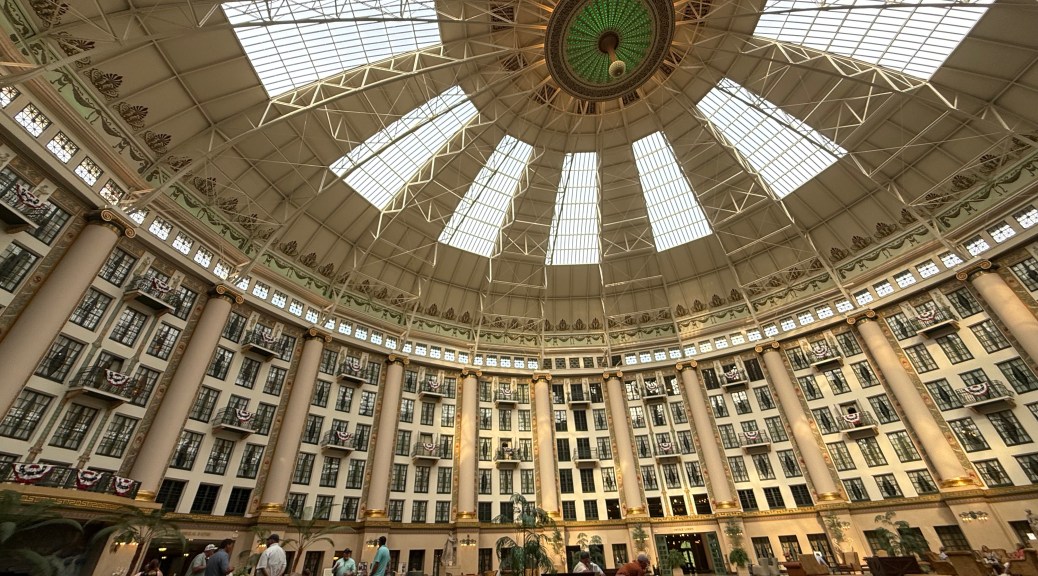
Which is exactly what I and three of my friends did last week, at the West Baden Springs Hotel. West Baden is three miles down the road from French Lick, both are grand old hotels that had once seen better days and now are all gussied up to their previous splendor, with a casino to punch things up.


My friends and I opted for West Baden, the more grown up of the two, no casino, no activities for young families. The idea of West Baden suited us much better and we chose wisely, I think. Not only was the place beautiful, the staff was friendly and attentive, but with a nice midwestern charm, nothing snooty or off-putting.


We were looking for calm spa experiences, lollygagging around in the spectacular atrium at West Baden, and moving languidly from one overstuffed chair to another, then out to the rockers on the veranda, and back again for afternoon drinks. We acquitted ourselves nicely. We took a scheduled tour of the West Baden Springs Hotel, learning all about its history that took it from hotel and spa to boondoggle to seminary and back again to hotel.


It was a pleasant way to spend an hour before an afternoon tea, each of us with our own generous pot of a personally chosen tea, our own little tier of sandwiches and sweets and scones. There was a harpist. Our pal who opted not to splash out for the tea settled into a little corner of the atrium where she ordered a hoagie and then texted us throughout with the names of the songs our harpist supplied. We were in another corner of the atrium, all fancy-like and pinkies out, knowing what she was really doing was making the point she got harp music, too, for a fraction of the cost.


We didn’t care. We were joined at our table by a delightful woman who was also on our tour. Her husband and twenty three of his friends were playing golf, and had come all the way from Texas to do it. Every year they look for a new place to play, the only non-negotiable thing is the proximity to a casino.


They golfed by day, gambled by night, and returned to West Baden to sleep in old world charm. Perfect, because West Baden and French Lick make it easy to sample all there is on offer without ever having to drive. Trolleys and little buses run in a loop and they will take you anywhere you want to go–the other hotel, to restaurants in town, arcades and grocery stores.You can even summon them from out in town, if one isn’t on the horizon.


You will need your car for some things, but we parked on Tuesday afternoon and didn’t move it until Thursday morning, when we stopped by Nila’s Place on the way out of town. Perfect omelettes, by the way.

Nancy and I had massages scheduled as soon as we arrived at the hotel, and it was there I fell in love. With the spa robe.


The gigantic, soft and luxurious spa robe. I had to have it. Or one just like it. Sadly, they haven’t stocked them since COVID, but the always friendly staff helped me find the maker and with just a few clicks of the keyboard, I have one just like it on the way. What makes them so wonderful? My research tells me spas provide you with humongous robes, at least 4X, maybe 5X. So perfect for the drape, the weight, the cozy, the decadence of it all.


We did just about nothing. We did some things together, some things alone. Some of us got up early to walk. Some of us had breakfast at 10. It just worked out. Now, it wasn’t an inexpensive get away, but it was perfect for us and I could go back right now. I had forgotten how relaxing it is to have no expectations.


And the best thing? The very best thing? Getting there, getting home, was completely no stress. No Nashville traffic. No airport. We lingered at Nila’s, and still got home before 1:30pm. Can you put a price on that? No, you can’t so don’t even try.

x

Decoration Day, Then and Now

My grandmother called it Decoration Day and told stories of picnicking among the stones of her departed family members, in a prairie cemetery in Indian Territory, in what is now east Oklahoma. The Paxtons would descend on the windswept and flat parcel of land and spend the whole day. They sang. They played games. They cleaned the graves of dead flowers and planted new ones to be buffeted by the wind, but that was just fine, because it gave the impression of dancing, those bobbing heads, in a stark and lonely place, there, on the outskirts of town.


I think she wanted us to recreate the picnic at Elmwood Cemetery or, rather, she wished we could, but knew such a thing would be impossible, unseemly, not done. The story appalled my mother. But Granny never failed to mention it on those long-ago Saturday mornings as she popped the trunk and hauled out tools, watering cans and washtubs full of flowers.


We followed her, our Keds and Red Ball Jets growing wet at the toes, then cold and uncomfortable as we trudged up the small rise to the place where our people lay, all of them, a case of serendipity having orchestrated both sets of grandparents with plots in spitting distance of each other.


“Look for the statute of the girl missing a finger,” she called over her shoulder. “That is our landmark.” And there she is, Bernice Fitts, who left this world at the age of eighteen, a giantess missing a finger, pointing, and not pointing, in the direction of the grandfather I never knew.
We were always excited, but subdued, too. We understood, as much as we were able, that this was a solemn duty and there were things here, mysterious and big, echoes of Sunday sermons, bellies of whales, lion’s dens, the dead to rise again. All of it scary and thrilling and incomprehensible.


But it was fun, too. An outing. A tradition. We were not a family to visit the cemetery regularly; we didn’t decorate graves for the seasons, on holidays or the birthdays of the departed. We might wander up to Elmwood on a pretty day, a moody afternoon, but never to linger.


Yet, Memorial Day was sacred, although we never used that word. But to ignore it, to miss one, would wrack me with guilt, and my sister, too.


Now, we call up, half-ashamed, asking if the other has taken flowers to the cemetery, hoping the answer is yes, so we are off the hook. The answer is always, no. We scurry around then, and gather plants and a watering can, and tend the graves in the most perfunctory of ways. But we feel better afterward, and both of us sigh with relief and satisfaction as we pull out onto Breckenridge and get on with our day. A duty done.


My mother was in the habit there toward the end of buying hanging baskets she would place on the graves and retrieve later for her summer garden. This was a great idea I thought, yet it worried her someone would steal them, so she sent me out early on Tuesday morning to bring them home. And people do steal them. Never our pots because they weren’t special, just some impatiens, still too small to make much of a display, but the nice ones, the specially made arrangements, these disappear.


We need not discuss what makes people do this, how low-bred, how disrespectful. We know exactly the sort to help themselves to a remembrance left for a loved one. To dwell on it is to wish for a stone hut on an isolated island in which to live out our days, away from people, just about all of them. To give up on them.


And some days I do give up on them. But not most days.

And some days I remember so clearly being a child of four, seven, ten.
The cool and damp of a May morning, the bucket of peonies in my grandmother’s trunk, children running in a game to find their grandparents who are only stories to them, faded photos, this gray stone. Another child, or just so recently a child, her head bending on a slender neck, her upraised and fingerless hand, showing the way.

The Cost of Beauty

It started with a bar of soap. Almond soap. Triple milled, old fashioned, sophisticated and expensive, from a company that has been around since 1752. An American brand to rival, as the website says, “the legendary houses of Europe.”


And I paid full price, although with an eagle eye you can find this soap on the shelves at TJMaxx. I bought a sister soap a year ago, maybe longer, in an old, but upscale, pharmacy in St. Louis. Paid top dollar then, too. Like my grandmothers, I set it aside because I thought it was too good to use, saving it, or what? The day my nieces toss it in the trash at the final clearing out of my home ahead of the FOR SALE sign?

But no more. A fancy soap is a small luxury, within anyone’s reach and I am going to use it up, then order some more.


Here’s the deal. I grew up in a family with five kids vying for the one bathroom, and buddy, you have to be quick, and I was. I still am, and I wonder what my girlfriends think, when we are on one of our trips, all crammed into a big house or condo, taking turns getting ready. I am so quick surely they whisper concerns about how clean, really, could I be?
One of our pals takes an hour and a half getting ready. She really does. I can’t imagine what she is doing in there. To be fair, she never makes us wait for her. She knows how long she needs, and if we are leaving for a day trip at nine, she is about her ablutions by 7:30. She is sitting sweetly in the back seat by 8:58.


But this almond soap, you all. You have never smelled anything quite like it, and it inspires long baths, and showers, and lots of sudsy sensory enjoyments. I get it now, lingering at one’s toilette. Because I haven’t stopped at almond soap. Oh, no. I have researched lotions and potions and buffs and masks and I have set about procuring them, the better to scent and spritz and slather myself.


It is glorious.


I missed this in my formative years. As an adolescent I didn’t have lotion or powder, lip balm or eau de cologne at my disposal. Zest soap, Vaseline, and Champho-phenique were our signature scents. Along with mercurochrome and its evil twin, methiolate, a pair of tweezers and some adhesive tape, our family hygiene/first aid kit was complete.


What money I earned from babysitting was spent on book and 45’s culled from the bins at the Wax Works. My mother wasn’t fixy, and overwhelmed to boot, so we never had mother-daughter afternoons of magazines and nail polish, lip gloss and Dippity-Do. My friends weren’t particularly fussy, either, or if they were, it was carried out at home. We sometimes made fun of the girls who cared about their hair and engaged in those first attempts at being pretty, prettier.


We were a sarcastic bunch and ridicule was our game, and no way were we risking it being turned on ourselves within the tribe. Speaking for myself, my eye rolls and sneers for girly girls were in direct proportion to my own jealousy and inadequacy. Growing up with brothers who were brutal in their takedowns didn’t help, either.

My girls group, the same one from those long ago days, are all girly, now. Or maybe we are just trying to save our skin, quite literally. We sit around for hours with our sangria and blood pressure pills, little puddles of supplements we eat like peanuts, discussing moisturizers and facial peels, sunscreens and rash guards, foundations and eye shadow, having our eyes done–medically indicated, mind– and who’s up for pedicures later today?


Just this morning I was out looking for a soap saver to protect my delicious almond soap, triple-milled though it is. I don’t want to waste any of it. Later today a new order of facial cleanser and moisturizer will arrive, and I am contemplating foot masks.


My new goal is to clock myself as I go about my ablutions, set the ambition to take, if not an hour and a half, at least more than twelve minutes. Start a list of products and beauty tips to share with the girls, the next time we are together. Look forward to reveling in the experience as we giggle and gently tease each other, with nary an eye roll to be found.

Holiday Movies to Get You Through

One of my childhood chums loves her some Hallmark Christmas movies. She watches them on a loop this time of year. She is comforted, she says, by the predictable plots, the sparkly sets, the pretty people. Even the fake snow pleases her. She only half-way watches them, instead has them setting the mood for her holiday preparations. I don’t like them.

Here’s the plot I could get behind. The handsome or beautiful New York attorney or hedge fund manager returns home for the holidays, only to find their handsome or beautiful high school sweetheart in desperate straits trying to save the Christmas town, the family Christmas Inn or their Christmas tree farm. The successful big city sweetheart arrives and the old flame grabs them by the lapels and says, “Thank goodness you’re here. Get me outta this one-horse town, and I mean, PRONTO!”


Until the day that movie lands, here are some of my favorite holiday flicks, the old ones, and perhaps as sappy in their way as a Hallmark movie, but different. I can’t explain it. In the “Miracle at Christmas” vein, let me recommend “The Lemon Drop Kid.” Bob Hope at his best, a snowy New York with a cadre of characters all conspiring to pay off gambling debts while saving their skins, they come up with a plan to bilk the city out of charity funds by creating the Nellie Thursday Home for Old Dolls. But then, hearts change, fortunes change, and it is funny and sweet and thoroughly watchable.


“It Happened on Fifth Avenue” is a similar movie, and also full of improbable shenanigans that, in black and white is a delight to watch. It is hard to find out there, but worth watching if you come across it.


A couple of oldies to sit with when you plop down on the couch to take a rest, are “The Man Who Came to Dinner,” with a young Bette Davis, and “Christmas in Connecticut,” with Barbara Stanwyck, of undetermined age. Barbara plays a columnist who specializes in homemaking, kind of an early day Martha Stewart. Except, she has no homemaking skills at all, nor does she have the baby and husband that she writes about frequently.


A fancy magazine gets the big idea to highlight her home and hearth at Christmas and hilarity ensues. I mean, it is a farce of a movie but in the right frame of mind, it really is funny.


“The Man Who Came to Dinner” is performed as a farce, too, and you can imagine it performed as a stage play, which it first was.. Monty Woolley plays an obnoxious and arrogant radio personality who takes a tumble on some icy steps when dining with a hapless family in Ohio during a cross-country lecture tour. He sets up shop, receiving calls, well wishes for the good and great. Someone sends him a crate of penguins for Christmas, or maybe it is an otter. Could be a swan. He barks orders and commandeers the whole house. There are laughs, a love interest, and Jimmy Durante.


I am a sucker for anything William Powell played in, and I pretty much adore that old Myrna Loy, so “The Thin Man” makes my list because it is set at Christmas, there is a mystery, a wire fox terrier named Asta, bad guys, worse guys, and lots and lots of cocktails, all to remind us how sophisticated life in New York can be. Black and white as it should be.


 I wrapped presents to “Meet Me In St. Louis,” and I didn’t even have to watch the screen. I listened to the dialogue and recalled the whole movie in vivid detail, I’ve seen it so often. And I make no apologies for it. If Judy Garland bores you, or you don’t hold a special place in your heart for Marjorie Main, then watch it for the very young Margaret O’Bryan. She plays Tootie, the youngest Smith sister, and she steals every scene she is in.


Perhaps my favorite Spencer Tracy/Katherine Hepburn movie is “Desk Set.” The action takes place almost exclusively at 30 Rock in New York, just a few days before Christmas. One of the first IBM computers makes a guest appearance as Tracy shows up to streamline the workings of the reference department, the one Hepburn heads.


Hepburn and her staff are the clearinghouse for facts and figures for the a nation-wide television outfit. They pull data from books, magazines and their own heads. They think that old computer will replace them. In these early days, it will not, not quite yet. Hilarity ensues.


And romance. And not a single Christmas tree farm to be saved.

Thanksgiving, My Way

The week has arrived, the time I can see my sweet family gathered around the groaning table, all sharp angled elbows and knees, girls in stiff blonde pigtails and patterned dresses, little boys with freckles and gap-toothed grins, as we admire the golden bird, mama in her cocktail apron and papa in a suit, a suit, mind you, big smiles all around, for Thanksgiving is HERE!


Someone ought to smack Norman Rockwell in the face.

No one’s Thanksgiving looks like that.


I have gone from nostalgic, warm-hearted, expectant, aggravated, downright mad, exhausted, and back again. I am hosting and the list of things to do has been long, with incessant trips to the grocery, the hardware store, the on-line stores, and still I realize I have nary a decorative pumpkin to grace the dining table.


And right about now, I don’t care.


My sister sets an impossibly high standard with her home decor. Her house would be festooned with tiny pumpkins, exquisite turkey figurines, and other things I can’t name but find beautiful…the first five minutes I am there. Then the babies arrive, and I intend to hog them, and nephews and nieces arrive, and I want to hog them, too, but they are adults now and they no longer get the appeal of putting fat cardboard puzzles together.


So, my lovely guests will only have the struggling amaryllis on the counter to gaze upon. But the little ones will know right where to find the toys, and will make a beeline for them. From where I sit right this minute I spy two toy trucks, purposely placed by my nephew, Cy, “charging,” just like the Roomba he is obsessed with. I debate moving them. He will look for them as soon as he hits the door.


There has been more to pulling the house together than I anticipated. Fortunately, I have my pal, Ruth, who was here two days in a row and worked me like a dog. She worked, too, and honestly, I would be in a weeping, wobbly mess right now if it hadn’t been for her. She should be around my table on Thursday, too, come to think of it, so grateful am I for her help and friendship.


As I write this I am in the early stages of making Chef Jean Pierre’s turkey gravy. It will take hours. But gravy is my spirit animal and I could eat it with a spoon, and have. That I can make it early and reheat it on Thanksgiving with no ill effects, well. I’m pretty grateful for him, too.
Early this morning and driving to get the last of my cooking supplies, I worked myself up into a right state. So put upon, so taken for granted, what was I thinking? But then a checkout person was kind and helpful, and I felt–begrudgingly–my mood lift a bit. Still not done with it I called an old childhood friend, and she finished lifting my mood the rest of the way.


In my snit it occurred to me I might ask for help from my dear hearts. What a concept. They are not mind-readers, after all, and then I thought of my Granny Opal, a widow who didn’t drive, spending a solid week preparing for our Thanksgivings. I always helped in the kitchen the Wednesday before Thanksgiving, but that was about it. Her table would already be set, the house warm and inviting. I honestly used to think she loved preparing for us, all of it, the cooking, the cleaning. But, did she? Who knows? I am sure no one ever asked her.


So, I sent out the word: I need someone to bring me two large bags of ice. Go get the dishes and silverware from Kathy and bring them over here. Here is what I will have around here to drink, feel free to bring whatever libation you might enjoy. Come early if you want, and I would love that. Appetizers at one. We will eat at two.


Watch out for Cy’s trucks tucked under end tables. And please leave them alone. They’re charging.

The Scent that Was, and Wasn’t

There, in the middle drawer of the marble topped washstand in the hallway of my childhood home is where my mother kept them, neat and in their boxes, the wicks blackened and waiting from one holiday season to the next.


She kept them there because we couldn’t abide the smell, or thought we couldn’t, and I wonder now if we just said that because, wretched children that we were, we found it hard to let Mother have anything of her own, truly her own. It went against the script, somehow, and if she got used to this one small thing, what could be next?


She kept them there because that was where she lit them, in all their wobbly glory, on the one surface in the house that was the least likely to be set aflame.


Bayberry candles.


Fragrant and the color of split pea soup, they perfumed the small hallway when she lit them and freighted the drawer on the odd summer day one of us might open it in a last ditch effort to find a pair of scissors or paste. There was never any misplaced treasure or tools in those drawers, just folded tablecloths and real napkins, lacy things dragged out for Thanksgiving and Christmas dinner when we still did that.


Maybe a small portrait in a Victorian frame of some relative no one remembered rattled between the candles and a small dish of errant buttons, straight pins. But as for a good place to prowl, that washstand was a gasping disappointment.


Mother loved bayberry candles because they reminded her of her childhood, perhaps her own mother, whom she lost when she was eight. We irritated her and drew sharp words when we complained about her other eccentricities, but as for the scent of bayberry, it was if she didn’t even hear us, would smile in a way that was unfamiliar, and tell us, gently, to use the backdoor if the scent was too much.


Which is why I sit here this morning with a lit votive of bayberry, trying to coerce the scent of my childhood, the better to remember my mother and that smile. It is tough going. The candles I ordered were crafted of the waxen berries of the bayberry shrub. The packaging is beautiful, with a little card explaining the significance of bayberry in colonial times, especially at Christmas and the New Year.


The color of the votive and the tapers I also bought is right. The same green that is neither bright nor dull but its own color, distinct and evocative. I opened the box with much anticipation, expecting to be hit with the smell, one I have come to love. But nothing.


Well, I reasoned, being made from the real thing, of course the scent would be subtle, coming into its own once lit. And still, nothing. I see now the fancy box says the candle is “real bayberry wax,” and maybe that makes a difference. My mother ordered hers directly from a shop in Colonial Williamsburg, a place near to her heart, and in our family this must surely have been a big splurge.


Maybe her candles weren’t “real” bayberry at all. Or, maybe these candles of mine are sub par and I was seduced by the packaging. And, perhaps this is important as the holiday season approaches because I am missing my mother.


I see now I have to replicate, not the candle, but the scent. And not just any old bayberry, but the right bayberry. Research must be done. I have long given up trying to replicate that one great party, the one big time at the end of summer. The perfect birthday. The spontaneous drop in visit that lasted deep into the night, all the world’s troubles solved.


But I must replicate the bayberry of my childhood.


The old washstand sits in my living room now. The top drawer holds boxes of handwritten recipes, the tops of the cards furred with age and use. The remaining drawers, all the things I don’t know what to do with–DVDs, pulled pages from glossy magazines, journals and calendars.


As we welcome a new generation of family, most so little yet we can’t risk open flame anywhere near them, surely there is a place for a box of fragrant tapers packed away in a drawer, with scent of bayberry escaping through the joinery, somehow whispering the important thing.
Surely, this thing I can find.

French Monasteries and shhhh….No Talking

Toward the end of September I met up with nine of my high school friends in Florida, a week ahead of Helené, most of us in one big house, and I am hear to tell you, my ears are still ringing. I don’t know that we were overly loud, although we were certainly chatty. It’s just that my life for a long time now, is very quiet.


If I want noise, I head to my niece’s, the mother of toddler twins and a three-year old. They giggle, they cry–real tears or fake ones–the dog barks, sometimes at nothing, although she may be begging passers-by to rescue her from the madness. She is old and seems thinner than normal. I worry about her, until I see that both twins quite enjoy her kibble, and they walk around with it on their breath or soggy bits stuck to their shirts.

I like noise and activity for a little while, and then I need to read a book.
When you read this I should be just back from a quick trip to Canada. I wanted to hear a foreign language spoken, but I wasn’t up for a transatlantic jaunt. I talked one of my high school chums into going with me. It was back last December and we had to make a quick decision, and our calendars were pristine and free from obligation for October.
That was before the Florida trip came up. And for my pal, Nancy, since summer she has run from the Lake of the Ozarks to Philadelphia to keep her grandchildren, to Florida, and a day after returning from that, a road trip to Hilton Head, with a three day space before we were to leave for Quebec. On most days, trips or at home, she plays early morning pickleball. She says she is tired and overwhelmed.


Well, I reckon.


So, I found accommodation in an old 1600s monastery, right inside the old city walls of Quebec, and there we will stay in our separate monk’s cells–the updated ones–and we will toddle down each morning for a silent breakfast.


Oh, yes, in the best contemplative fashion, no talking at breakfast, and I couldn’t be happier. She’s surprisingly open to it, too. The reviews for the place are outstanding, except for the complainers who didn’t read the fine print. The guy who booked it for a father-son getaway, for example. The party boy who was put out by the quiet hours from ten at night until the next morning.


Some missed the fact that for the traditional rooms the bathrooms are down the hall. I have stayed in monasteries before, so you better believe I knew to check, and we snagged contemporary rooms, with our own baths. We can have a tour of the monastery, but really, the whole place is like a museum, and I look forward to starting each day in silent reflection and walking through stone passages on my way to find poutine and t-shirts.
I plan to buttonhole my friend, too, and see what all this activity is about. It isn’t just that I feel slothful by comparison, but I don’t get a sense she loves it, or even likes all this activity very much. We have another friend who was also on our girls’ trip to Florida and she goes all the time. I mean, all the time and if by sea, all the better. If she could take a cruise ship to St. Louis or Chicago, she would. She’s on a ship right now. She seems to thrive.


So, with luck, Nancy and I will get to poke around Quebec and Montreal, find a maple leaf toque and a Detroit Lions hat for her husband. He’s put in a request. We will probably shop for ourselves, too, and pick up something for our various little ones. And maybe, with the help of serene surroundings and a meditative atmosphere, I can figure out how to make myself get up and get moving and she can figure out how to let herself stop.

To See What I Can See

One of the best things about our trip to South Dakota was how doable it was for us, women of a certain age. Every morning we got up, had a nice coffee at the little place next door, and then we took off. Our loft apartment was just on the edge of the original downtown and close to all the roads point north or south or east or west.


Because everything is more or less flat and full of space the roads were straight and uncrowded and there was very little squabbling over directions and I only had to admonish Donna twice for talking over the nice woman inside my Maps app, who tried to give me directions.


We just got in the car and went. We could as easily have been heading to Nashville for Christmas shopping, or to Louisville for lunch with Nancy, except our way was considerably more restful. No traffic. We piddled around, mostly, stopping at Sturgis to look at trashy t-shirts, getting that free ice water at Wall Drugs, meandering through the Badlands, pulling over at least ten times to gawk and take selfies.


The selfies were Donna’s idea. Her daughter-in-law had a birthday that day, and she wanted to send Emily greetings from all our stops. The cheesier the better. I’m guessing the new wore off for poor Emily about midday, but we kept it up until almost dark.


We followed the Griffin Rules on this trip. In Donna’s family they would get up at a reasonable hour, have a big breakfast, or at least a good one, take off for the day, maybe have a little something around 1:00 pm–ice cream being a favorite–then get back to the hotel for a nice dinner somewhere. It worked great for us, even though I am more of a get up and get going kind of person. But because we were on the road no later than 9:30, my nerves and goodwill remained intact.


Every place we stopped, even privately owned attractions like Crazy Horse, had a welcome center and a small theatre where informational films aired every twenty minutes or so.


Watching every such film is also a Griffin Rule. Donna admitted her kids didn’t like them much, but she and Otis wouldn’t miss one. I don’t like to miss them, either.


Most are old and scratchy. I am pretty sure we didn’t see a single one produced after 1985, but this only added to their charm. At Mt. Rushmore we learned the background of the sculptor, Gutzon Borglum. Did you know he studied in France and became a close friend of Auguste Rodin? Me, either.
In a little museum off the hallway was a display of the equipment the cutters used, including the swinging chairs in which they dangled off Roosevelt’s nose, but I was only able to identify them because I first saw the film in the little theatre.


I was most struck by the immense spaces set aside in the parks for recreation, especially passive recreation. Meadows, lakes, little overlooks. Plain old roadsides, with no one approaching from either direction. At one visitor’s center, I can’t remember which one now, a family with babies, grandmas and children lined the small foot bridge spanning a creek, most with fishing poles, angling in the shade of a cottonwood tree. Right there, not ten feet from the parking lot, just camped out for a pleasant afternoon.


It looked perfectly natural. There were no signs granting or denying permission. It echoed the freedom to be had out there, where there is room for everyone, to breathe, to be left alone. Donna said last week she was ready to go back out west. Me, too. I worry sometimes that I am too old for such a trip, that somehow if I am in Colorado, say, I have to hike or ski or mountain bike, or why go?


Now I think it is perfectly reasonable to go and look, and see. Catch the direction of the breeze. Hike a little if you want to, although John Muir, who embodies all the wild spaces, said he hated that word. That we should saunter through the woods, not hike. Hiking is work. Sauntering, a word derived from the journeys of pilgrims, is a joy.
And I can saunter with the best of them. And I can gape through a windshield or from a park bench. But first, the film.

Prairie Love

There are studies, I suppose, on the ways our physical environments shape us. I don’t mean the obvious environment psychologists talk about; the neighborhood, the house, the presence of books or harsh words. I mean the environment outside the window, the creek, the mountain, the wide open sky, a fence row that goes on forever, the next house a speck on the horizon.


Or no house on the horizon, and sometimes no horizon, either. Where I live, where I have always lived, I must go in hunt of the skyline, and it is a drive.

South Dakota is a land of horizons, of prairie, a place where standing on a second floor balcony the rain comes in from off, signaled by darkening sheets of rain too small to cover the whole horizon, just a part of it. The rain moves back to front, or left to right, and it will reach you some time, but leaving you plenty of time for speculation and a chat.


I want to drive across Nebraska. I am told this is because I have never driven across Nebraska. That the wheat and road are incessant, a trial to be endured, not enjoyed. But I don’t know. I think that sounds like a wonderful thing to see and do. Drive and drive, scenery unchanging, but new to me, and therefore, exciting. The prairie grass rolling like waves, and what it must be to see a rise in the landscape, to see the change coming but not able to judge the distance, not quite yet, and if at all.


I asked people I met out in South Dakota what it was like growing up with the Black Hills for a backdrop, to drive an hour and be in the Badlands. To have so much sky. They smiled and said it was nice, and didn’t quite get the question, as I wouldn’t quite get the question if put to me. One woman said her father, who was a rancher, never looked at the sky all that much. His grandchildren asked why his walked with his head down, always down.


“I raised cows,” he had said. “I have to watch where I step.”


But this must be the exception, surely.


I don’t realize how flat Daviess County is until friends from Eastern Kentucky point it out. They find they can only be away from their mountains for just a little bit before they miss them, the “sheltering hills” James Still wrote of. I can only be in those same mountains for a few days before they begin to close in on me, make me work a little harder to breathe. So, not sheltering to me, but oppressive.


Give me the same mountains farther south, in Tennessee. Then I am tenderhearted toward them. But that is because they roll differently there. Towns and bergs are nestled in broad green valleys, valleys we can look down into from overlooks or the high winding roads. A vista of sorts.


My mother’s people came here from England. I can almost prove it on paper, I think, but I can prove it for certain when I travel there. That green and pleasant land. The gentle landscape that is broad and human-scaled. The fields and meadows, the hillocks that ring a village, the ones with the benches at their crest, inviting us to sit and gaze out on the houses below, and watch the sky change from blue to gray to navy.


I have sat on such benches and feel, in a visceral way, that it isn’t the first time I’ve sat there, and not in this century. I do a lot of sighing then, content, and warm with affection, as I catch my breath.


I feel the same in Ireland, where every rock-bound field sits not too far above sea level. They have their mountains, I think of the Wicklow Mountains, but they are gentle and promise, as one travel books said, “sweeping views and plenty of space to sit and have a cuppa.” Stand at Cumberland Gap and wonder how this could have been the best spot to cross into the West. Then meander up and down Sally Gap Drive in the Wicklow hills for comparison. And there is no comparison, none at all.


Willa Cather, American writer, was born in the Shenandoah Valley, but grew up in Nebraska. She knew something about about mountains, and also vistas, and open sky. She says, this, about that:


“Anybody can love the mountains, but it takes a soul to love the prairie.”


What soul I have for landscape, sits beside Willa Cather’s.

Wall Drug and Then Some

Our first outing was for ice water. Free ice water and sixty miles away. We giggled the whole way there. My pal, Donna, and I had arrived in Rapid City, South Dakota and on our first morning we decided it was too overcast to rush over to Mount Rushmore. We would go to Wall, SD, first and stop in at the drug store for some free ice water.


And cheap coffee.


And donuts.


Last December I found myself with some airline credit that had to be used up so Donna and I headed west to make up for a driving trip we had cancelled during COVID. I had a package to mail, so I brought it with me, and we headed to Wall Drug, with intentions of mailing that package, seeing what all the fuss was about, besides ice water, and then to head into the Badlands.


Well. I have to say, kitsch though it may be, Wall Drug was a favorite, starting with the Burma Shave-like signs that began showing up, twenty miles out. The story goes, Ted Hustead and his young family bought the l drug store in the tiny town of Wall, population 326, in 1931. Giving themselves five years to make a go of it, the timeline was almost up, when his wife, Dorothy, lay down for an afternoon nap one hot and miserable Sunday.


She got up fairly quickly, with an idea of how to entice all the travelers rolling down highways 14 and 16, just outside Wall. Those people are thirsty, she said. What do they want? Ice water!


She had even dreamed up the little jingle that would bring the travelers in. 
 “Get a soda…get a root beer…turn next corner…just as near…free ice water…Wall Drug.”

And that, my friends, is how you do it. After the homemade signs went up out along the prairie roads, the cars started coming and they haven’t stopped since.


Now, Wall Drug is just about what you would expect. A sprawling enterprise that takes up an entire city block, one can envision an Old West wooden sidewalked city block, and it has so many little shops and emporiums it is hard to locate the original Wall Drug store. But it is in there somewhere, and I bought some fancy sea salt lotion, just to prove it. They have old timey picture studios, with hat and bonnet props, gem and rock shops, any one of several souvenir shops, and stations out back for all that free ice water.


On the day we visited the water was dispensed from a regular soda fountain, but it was very cold. I know I am suggestible, but I defy you find colder water anywhere. Donna generously treated me to that five cent coffee, which I couldn’t drink, but she enjoyed because, you know, a nickel. I would have gladly paid a dollar for someone to take it from my lips.


But the donuts!


Oh, my, the donuts were wonderful. And I don’t usually like this kind of donut, but these were warm and cakey, but also a little yeasty, and I have no idea why we didn’t buy an entire bag of them–they were sitting right there on the counter–but now I want to see if they can ship them.


It is a roadside attraction of the most American kind. The coffee and donuts were added to the tradition when they installed the Minuteman missile silos in the area. The Husteads figured the military personnel would want cheap hot coffee and donuts on their travels to and from work. And, it turns out, so did we.

We spent an hour wandering around like good tourists do, and headed out for the Badlands, a place I have heard of forever but couldn’t have described to save my life. There is much to say about them, and I will, but for now, two words: prairie dogs. Okay, three words: prairie dog villages.

Ask anyone and they will tell you, I am not much of an animal lover. But, you all. I have never seen anything cuter than those little praise dogs. And they really do live in villages, and they, along with my donuts and ice water, were my first introduction to South Dakota and I was smitten.