Tag Archives: summer gardens

The Nature of Things

The mornings are nice to sit outside, drink coffee and contemplate the world, one’s life or even the laundry piling up in the basement.  I was doing all these things a couple of mornings ago, when a tiny rabbit sidled along the walk, hesitated, sniffed the air, then headed for the hostas by the back door, disappearing for good. 

I don’t take much notice of the rabbits in my yard, especially since I learned to forgive them their lapin ways, eating all my tomato plants as they do.  We just coexist now in an easy acceptance of each other and I feel all  Beatrix Potter when I see them, then quickly return to my own thoughts, my own business at hand. 

But that morning I sat up and felt a swell of tenderness, whispered, “oh, you made it.”  And  I was one with the universe for a moment.  

I hoped this little fellow was one of a fluffle my young friend, Sterling, and I unearthed by accident a few weeks ago.  She was handling the shovel, I was giving directions, as she dug a shallow hole in the flowerbed along my side porch.  We had just pulled up a lemon verbena that threatened to take over and one I was tired of.

The ground is unusually soft there, which is fortunate, because Sterling didn’t have to dig too hard to turn the earth.  On the second scoop of the shovel, she gave a little cry. 

There was a baby bunny wriggling and squinting and squirming not four inches below the surface.  We came closer and no, not just one.  Three, four baby rabbits, maybe more. 

To her credit, Sterling took it much better than I.  It horrified me a little.  But she asked quietly what we should do, and then, not waiting for a reply, began gently covering them back over.  We placed the pulled up verbena over the space and hoped for the best. 

It is a myth, I found out, that mother rabbits will not return to their babies if they sense human involvement.  Friends reassured me they would be fine.  My sister and brother-in-law have a rabbit maternity ward in their backyard, with rabbits routinely giving birth close to their house, and they watch the mothers feed their babies, toss them out of the little burrow to clean the nest, then toss them back in again.  

But still, I was afraid to check on my little boarders.  I just couldn’t do it. 

So, I was happy to see the hopping little thing hide in my hostas.  Later, I screwed up my courage and checked the hole, but not before researching how long baby rabbits stay in one.  It is a short period, two weeks, or so, and that time had easily passed.  They were all gone.  So gone from the place, if I hadn’t known they had been here, I would never have known they were there.  I planted my garden phlox as I had intended weeks ago, and marveled at it all.

I have friends who grew up along side creeks and woods and country lanes, or had grandparents they visited regularly in the country.  They talk about the Gaines woods, or Anglin Falls, or “the narrows.”  Sometimes they use words like “shoals.”  They speak lovingly of mud. 

And I don’t completely get it.  I like nature, but I like it manicured, neat.  Maybe it is the fecundity of our region, all that undergrowth and dampness, everything at certain times of year just on the verge of rot.  I will hike with you, but let’s do it in the autumn, or a crisp winter day, when the path is clear, when we can see where we are headed, when the trees aren’t dripping wet for no good reason.  

I had a colleague from Colorado who came to Kentucky in her early twenties on the Greyhound bus.  She left a place of wide expanses and rocky outcroppings, slept through the prairie, and awoke with a start in Kentucky, all the green, the lushness, the closeness of our landscape.  She had the heebie-jeebies for a week. 

She soon appreciated the differences.  Out west the landscape forces us to look out.  Here, the landscape requires we look down.  Under things.  Look with specificity, find grandiosity in small wonders.  Move carefully.  Know the ways of rabbits, snakes, birds. Study bugs and bark, the fallen trees rendering back to earth.  

I try to learn from my nature-bound friends.  It is a long, long lesson.
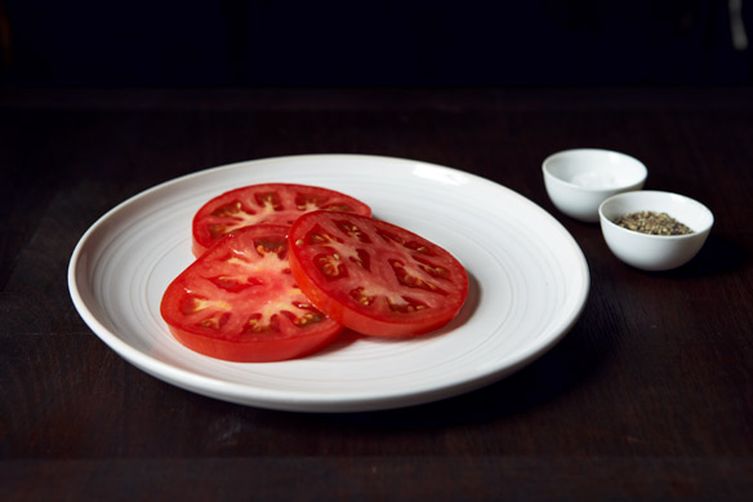
Summer Tomato

I saw the most amazing thing last week, amazing and delightful, and even now, I am not convinced what I saw and experienced actually occurred..think it may have been a phantasm or a hallucination, or at the very least overactive wishful thinking.

I saw a tomato.

A ruby ripe tomato, slightly smaller than a softball, the top neatly sliced off and reminding me of my grandmother’s kitchen in summer, where she prepared such tomatoes for our lunch.

But I wasn’t in my grandmother’s kitchen, wasn’t standing in the middle of a Kentucky summer, but rather, passing by the lunch table in our break room at work.
My colleague, Matt, was sitting there, enjoying his lunch—he eats well—entire meals left over from Sunday dinners—and at his elbow was the tomato. He had been delicately slicing himself pieces, one at a time, as he ate his lunch.

Stopped me in my tracks, did that tomato. Stopped my buddy, Al, too, and we gathered around the tomato, and Matt, with reverence and awe. Someone might have knelt. I’m not sure.

Matt is a wonderful fellow, and generous, and he offered us some, carved off two slices with a beatific glow, for he knew what he possessed was not of this wintry world, knew it was to be shared, knew other, more ethereal forces were at work here.

We took our offerings in trembling hands, sat down, eyes closed, and took our time—no greedy slurping and inattention, but rather a savoring, and when we were done, Al and I wore beatific smiles, too.

Because this was a summer tomato. A perfectly formed, low acidic, delicious orb of a fruit, as authentic as any of its summer brethren, worthy of a place in a roadside stand, nestled under a handwritten cardboard sign reading “home grown.”

Where, or where, did he get it?

His father gave it to him.

Now here, as in most miracle stories, the details get sketchy but I will do my best to recreate it for you. Matt’s dad lives in Union County, of this much I am sure, and he purchased the tomatoes from the Amish, or the Mennonites—of this I am less sure—somewhere in the countryside, Matt wasn’t clear.

I remember him saying something about a fund-raiser, but that doesn’t exactly square up when you think about it, and he said they were expensive. For some reason the figure of twelve tomatoes for thirty dollars sticks in my mind—quick math and that brings us to $2.50 a piece.

I envisioned the tomatoes snug in heavy cardboard boxes, some wrapped in tissue paper, some wrapped in thin gold foil, like those specialty pears we send at Christmas. I envisioned a rendezvous under the cloak of darkness, a buggy on some overgrown backroad, a kerosene lantern blinking out code, and tomato hunters inching their cars—lights off—toward the golden glow, dodging muddy potholes and low-hanging branches.

I envisioned a small child appearing from the shadows, dressed in somber clothing, a poke in one hand, the other an outstretched palm, reaching to receive the cash, horses whinnying and pawing the damp earth. I envisioned a hot house—say it isn’t so!—a hot house, where a sea of tomatoes are chugging along, under water or manure, ripening and ripening, and ripening all winter.

This is what I thought about as I ate my tomato, I don’t know about the others. Each of us sat in communal silence, thinking our own thoughts, contemplating the miracles of the universe, perhaps, and what forces of nature or fate or simple good luck brought us to this tomato.

Matt offered us more—there was still half a tomato left—but Al and I demurred, knowing, I think, that we had been given a rare and precious gift, and it doesn’t do to be greedy.

There is a poem, one I admire but can’t find, that speaks of eating fruit in its season. That there is no better joy. The poem is a cautionary tale reminding us to do things in their proper time, reminds us of the value of waiting, the wisdom of patience.

I embrace the sentiment of that and work to be patient and wise and proportional in my life, living the seasons as they present themselves to us, standing still in the moment, with joy and faith.

But oh, my, that tomato. Summer in a twinkling, and just like that, gone.

Pure rapture.