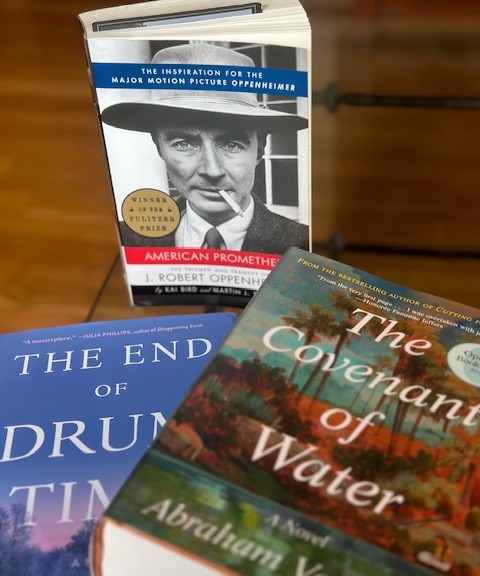
One great thing about having friends who read is that they share their reading lists with me. Right now I am gazing at a stack of books that have recently arrived and I am looking forward to the next rainy afternoon when I can sit with lots of coffee and a blankie so we can have a nice long visit.
Right now I am about a hundred pages into “American Prometheus,” the Pulitzer Prize wining biography of J. Robert Oppenheimer. I am reading it because my pal, Alice is reading it, and she is reading it because her granddaughter, Leah, is reading it. They are preparing to see the movie, “Oppenheimer,” in an IMAX theater in Nashville, and so much study.
It is big, in every way a book may be big, but it is so well-written I find myself feeling a bit unsettled if I don’t check in with Oppie on a regular basis. It gives the reader a fascinating glimpse into the world of Oppenheimer as a young physicist, but also Oppenheimer as an odd duck, but then, genius, I am told, often has its quirks. We meet other great scientists along the way, as Oppenheimer’s path crosses with some of the greatest minds in the field.
This book is a biography, yes, but also a work of history, weaving the personal, professional, and political into a fine strand of mid-century geopolitics. Don’t be daunted by the size of the book. The last hundred or so pages include author’s notes, footnotes, and bibliography.
Another book of some size is Abraham Verghese’s “The Covenant of Water.” You may have read his “Cutting for Stone” several years ago. It was a gorgeous book, the story, the writing, the cover, all beautiful. This one looks to be right up there with it. Set in the first seventy years of the last century, it is a story of three generations of an Indian family that “suffers from a peculiar affliction: at least one person in each generation dies by drowning, and in Kerala, water is everywhere.” This is from the dust jacket, but it goes on to tell us, this is a story of a bygone India, and it is also a study of the passage of time, itself. This sounds like a depressing premise, perhaps, but I can tell you, in Verghese’s hands the story will be beautiful, deeply human, and will linger with the reader long after the last page is turned.
Now here’s one. “The End of Drum-Time” is set in the frozen tundra of Scandinavia and is a love story and exploration of faith, culture, and history as they bump up against the Indigenous Sami people. As an anthropology student, studying the Sami was just about my favorite thing. Here is a fact I will share. They tend to have very round heads because the Sami gently pat and shape their babies’ noggins, thinking, as they do, that round-headed babies are the most beautiful. And they are.
My night-time reading is an old John Le Carré, “Tinker Tailor Soldier Spy.” This is a really good one, a novel based on “The Cambridge Five,” who were uncovered as KGB moles during the 1950s and 60s. In fact, Le Carre’ is credited with popularizing the word “mole” for a traitor spy. He should know all about spy craft, having been a spy himself.
I will confess here I have to go back and re-read chapters since I often fall sleep as I am reading, but I don’t mind. The story is good and the characters companionable, and I have always had a thing for shambolic old George Smiley. He is brilliant in his unassuming way, and that is always attractive.
 Greta McDonough