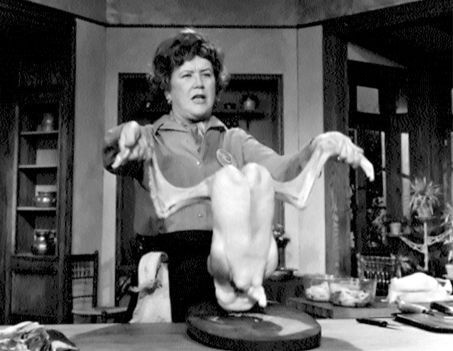
With construction in the back yard a continuing and noisy mess, I have turned to old episodes of Julia Child’s The French Chef to soothe me. These are the original PBS shows, shot in black and white, the shows and the recipes housewives all over the Boston area fell in love with when they tuned in to WGBH, their local public television station. These shows first gave us Julia and that voice, that presence.
And about that voice. Distinct, yes, but not the caricature we all know, and let’s be honest, the one we have all mimicked. I am ashamed of that now, because this early Julia is delightful and no-nonsense and she only wants to help us feed our families well. And if we feel pride in that accomplishment, even better.
I hopped up after the first episode I watched and I made the perfect French omelette. Yes, I did. Thanks to Gordon Ramsay I had the first part of the process down cold, but the slide and flip, that is all Julia and now, I can’t wait for some overnight company to show off my mad skills come morning.
I am not going to tell you how easy it is–but it is. It’s just eggs and butter after all, but it is what you do with them.
And here I confess I don’t want to tell you about the omelette at all and I don’t want you to be able to make one. It is small, petty of me, and I know it. But then, it occurs to me that Julia Child, a Cordon Bleu chef, dedicated herself to demystifying French cooking. She wanted to share her skills and expertise with us, and so in a spasm of entente, hands across the water and all that, here I am.
The first episodes were filmed in 1963 and, unless you remember TV in that era, they can be challenging to watch. The drab gray tones and soft contrast of the film give everything an anemic look, and the food suffers the most. We must take Julia’s word for it, how pretty the dishes look, how presentation is as much a part of a meal as the meal itself. Even the beef looks ashen, the parsley black as ink. It’s a hurdle to get over.
So are some of the recipes. She dedicates an entire show to aspics. They were big apparently, and let’s leave that right there. No, thank you, I say, and no, thank you again. But in that first season she also shows us how to make French onion soup, boeuf bourguignon, cassoulet, and crepe suzettes. Roast Duck a l’orange. Pâte à Choux.
And she shows us in half an hour.
If you watched the HBO series, “Julia,” you know that during each show the floor around her feet was cluttered with assistants and producers crouched down and handing her things, taking the dirty bowls, making her look efficient and prepared. No doubt this aided in her producing the meals in half an hour. It is fun, then, to watch the original shows and try to imagine what is happening just out of sight. Sometimes, as she walks the dish to the dining room at the show’s end, you can see her step around what surely must be people.
And here I will say, fans of Julia Child owe a debt of gratitude to Sarah Lancashire for her portrayal of Julia. She doesn’t attempt to replicate her voice, the timbre and pitch. What she does, however, is capture the warmth and generosity of the woman, her little eccentricities in speech patterns, the tilting of her head, the way she catches her breath and closes her eyes as she thinks what to say next.
So, as the hammering continues just outside my kitchen, as the sawzalls rip and grind and make me think they are coming through the foundation, I sit with Julia and index cards. I replay her slicing an onion, dismembering a chicken, whisking a sauce. I sit and bask in smugness when she talks about tarragon, how hard it is to find it fresh. Not at my house. It grows right outside my door.
I find her old episodes on YouTube. I almost forgot to tell you that. But never let it be said I am one of those cooks who omits the most important thing. I hate those cooks. Just don’t share it at all if you are going to be like that. And to the rest of us, bon appétit.
 Greta McDonough